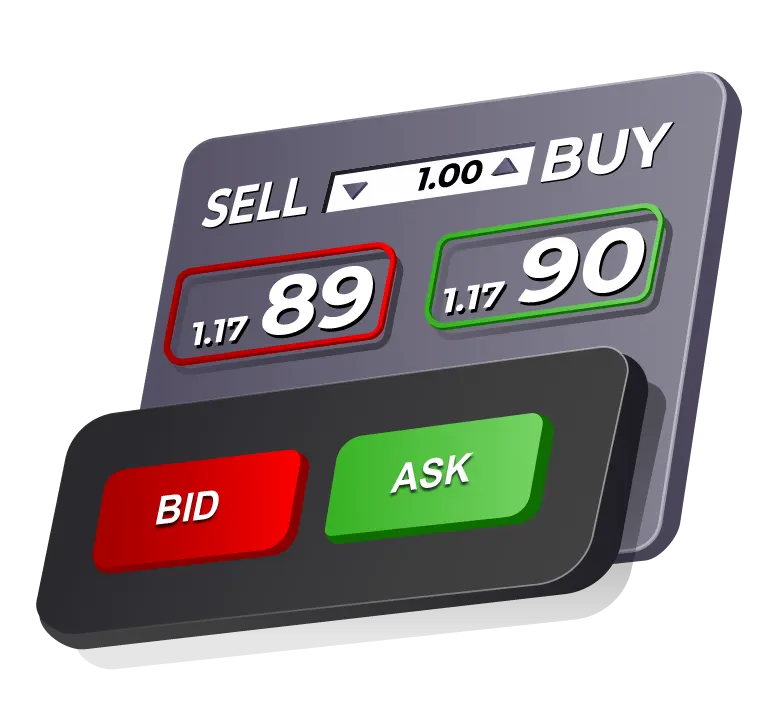
In this article, you'll discover what a spread is and how to calculate it. You'll also learn why spreads widen and the difference between fixed and floating spreads.
Let's dive in!
Content
What is a spread
How to calculate the spread
Types of spread
Floating spread
Fixed spread
Conclusion
What is a spread
The spread is the difference between the buying price and the selling price.
In the forex market, brokers offer two prices: the BID price and the ASK price. You buy the currency pair at one price and sell it at the other. The spread also acts as the broker’s fee for providing access to the market.
The commission, shown in monetary value, depends on your position size. In the next section of this article, you'll learn how the spread is calculated in money.
An example table shows the spread of some of the main currency pairs.

Currency pair | Spread in pips |
|---|---|
EUR/USD | 0,1 |
USD/JPY | 0,2 |
GBP/USD | 0,2 |
AUD/USD | 0,4 |
USD/CAD | 0,3 |
How to calculate the spread
The image shows the quote for the EUR/USD currency pair.
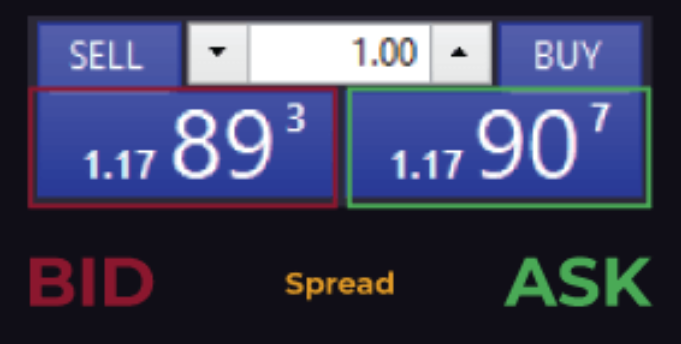
To find the spread, you need to subtract the BID price from the ASK price.
1.17907 ASK - 1.17893 BID = 0,00014
The spread is measured in pips, with a pip being the fourth decimal place. In this example, the spread is 1,4 pips. The monetary value of a pip depends on your position size, which is the lot you're trading.
One standard lot is 100,000 base units.
If you trade 1 lot (100,000 units) on EUR/USD with a 1,4 pip spread, your fee will be $14. For a 0.1 lot (10,000 units) trade with the same spread, your fee will be $1.40.
Discover what to trade and the best times to do it with our complete beginner's guide.
Forex Trading: A Complete Guide for Beginners
A comprehensive guide to getting started with Forex trading. If you're looking to build a strong foundation, the tips and steps in this guide will be highly beneficial.
Types of spread
There are two types of spread:
- Fixed;
- Floating.
Fixed spreads are typically offered by brokers that operate as a 'dealing desk,' while floating spreads are provided by brokers that follow a 'no-dealing desk' model.
Floating spread
With this type of spread, the difference between the buy and sell prices of currency pairs changes continuously.
Brokers obtain currency pair quotes from various liquidity providers and pass these prices directly to traders, without influencing the spreads.
As a result, spreads fluctuate based on the supply and demand of the currency pair and market volatility.
Spreads usually widen during significant economic events, such as:
- NFP;
- Election outcomes;
- Gross Domestic Product (GDP) reports;
- Unemployment figures, and more.
Spreads also tend to increase during low liquidity periods, like weekends or public holidays.
Start trading with some of the most competitive spreads available.
Trade with a TOP European broker
VSMarkets is a premium broker for online multi-asset trading. Licensed by a European regulator, VSMarkets offers 300+ trading instruments, 24/7 support, and negative balance protection.
Fixed Spread
A fixed spread remains constant regardless of market conditions, even during news events.
This type of spread is typically offered by brokers known as market makers or 'dealing desk' brokers. In this setup, the broker acts as the counterparty to their clients' trades.
These brokers can offer fixed spreads because they control the quotes they provide to their clients.
Conclusion
The spread represents the difference between the bid and ask prices, and it also serves as the fee a broker charges traders for providing access to the Forex market.
It is measured in pips, where 1 pip is the fourth decimal place in most currency pair quotes, except for pairs involving JPY, where the pip is at the second decimal place.
To calculate the spread, subtract the bid price from the ask price.
Spreads can be either floating or fixed, depending on the broker's terms. In highly volatile or low-liquidity markets, spreads may widen significantly.





Risk Warning: Trading involves a high risk of loss and is not suitable for all investors. All products and services offered by "Forex Trendline" Ltd are for educational purposes only and do not constitute investment advice or trading recommendation. Trading in financial instruments carries a high level of risk and may result in losses. Past performance is not indicative of future results. We recommend that you read the full Terms and Conditions before using our website and services offered. Nothing on this website should be interpreted as investment advice from "Forex Trendline" Ltd or any of its representatives, directors, or employees.
© 2026 Trendline. All rights reserved